


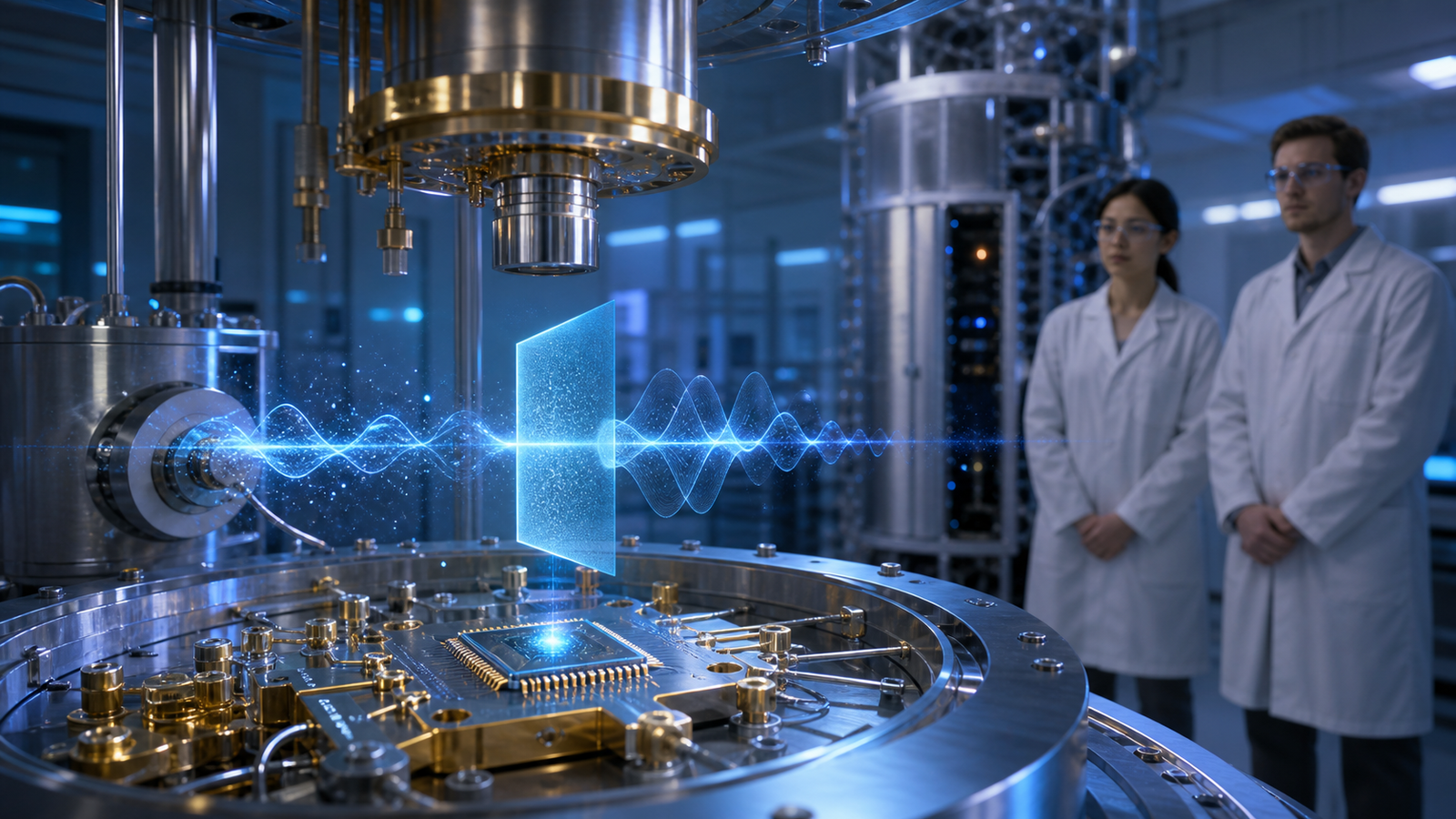
The 2025 Nobel Prize in Physics recognized John Clarke, Michel H. Devoret, and John M. Martinis for discoveries that showed quantum behavior can appear in electrical circuits large enough to be engineered and measured. Their work on macroscopic quantum mechanical tunneling and energy quantization helped build the foundation for modern superconducting qubits and quantum computing.
By Editorial Team | Updated June 19, 2026 | Reading time: 10 minutes
Introduction
Quantum mechanics is famous for strange ideas such as particles acting like waves, objects existing in multiple possible states, and particles crossing barriers that classical physics says they should not cross. For a long time, these effects were mostly associated with tiny systems such as electrons, photons, and atoms.
The Nobel-winning work of John Clarke, Michel H. Devoret, and John M. Martinis helped change that picture. Their experiments showed that quantum behavior could be observed in a larger electrical circuit made with superconductors and a Josephson junction. This proved that quantum mechanics is not only a theory for microscopic particles; it can also describe carefully designed macroscopic systems.
This article explains quantum tunneling, wave functions, Cooper pairs, Josephson junctions, macroscopic quantum tunneling, and why this research matters for quantum computers.
Table of Contents
- What was awarded?
- What is quantum tunneling?
- The wave function explained simply
- What is a Josephson junction?
- Macroscopic quantum tunneling
- How the experiment worked
- Why the discovery matters
- Connection to quantum computing
- Timeline of key events
- Key concepts and terminology
- Frequently asked questions
- Conclusion
What Was Awarded?
The 2025 Nobel Prize in Physics was awarded for the discovery of macroscopic quantum mechanical tunneling and energy quantization in an electric circuit. In simple terms, the laureates showed that a specially designed superconducting circuit could behave as one large quantum system.
This was important because quantum mechanics is usually easiest to observe at extremely small scales. Their experiments showed that, under the right conditions, a collective electrical state involving many particles can still follow quantum rules.
The result helped connect fundamental physics with practical technology. Today, superconducting circuits are one of the leading approaches used to build quantum computers.
What Is Quantum Tunneling?
Quantum tunneling is a phenomenon where a particle passes through a barrier even though classical physics says it does not have enough energy to cross it.
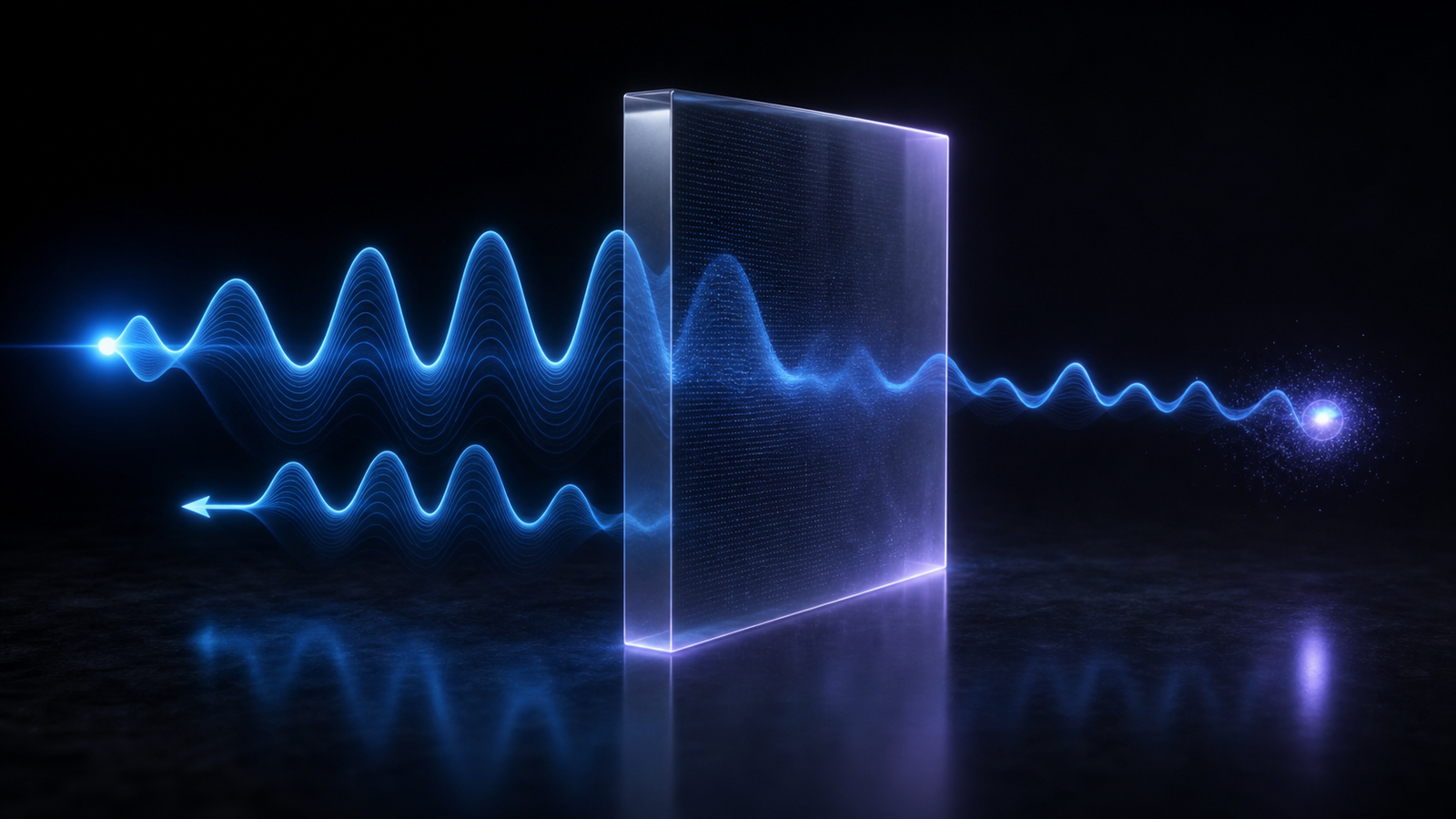
A simple analogy is a ball rolling toward a wall. In everyday physics, if the ball does not have enough energy to climb over the wall, it bounces back. At the quantum scale, however, an electron or another quantum particle can sometimes appear on the other side of the barrier.
This does not happen because the particle secretly drills through the wall. It happens because quantum particles are described by waves of probability. Part of the wave can extend into and beyond the barrier, creating a small but real chance that the particle will be detected on the other side.
The Wave Function Explained Simply
The wave function is a mathematical description of a quantum system. It tells scientists where a particle is likely to be found and how likely different outcomes are.
In classical physics, an object usually has a clear position. In quantum mechanics, a particle can be spread out as a probability wave until it is measured. The height of the wave is connected to the chance of finding the particle in a certain place.
When a quantum particle reaches a barrier, part of its wave function reflects back, but part can leak through. Because the wave does not always drop to zero inside the barrier, the particle has a nonzero chance of appearing beyond it. That is the heart of tunneling.
What Is a Josephson Junction?
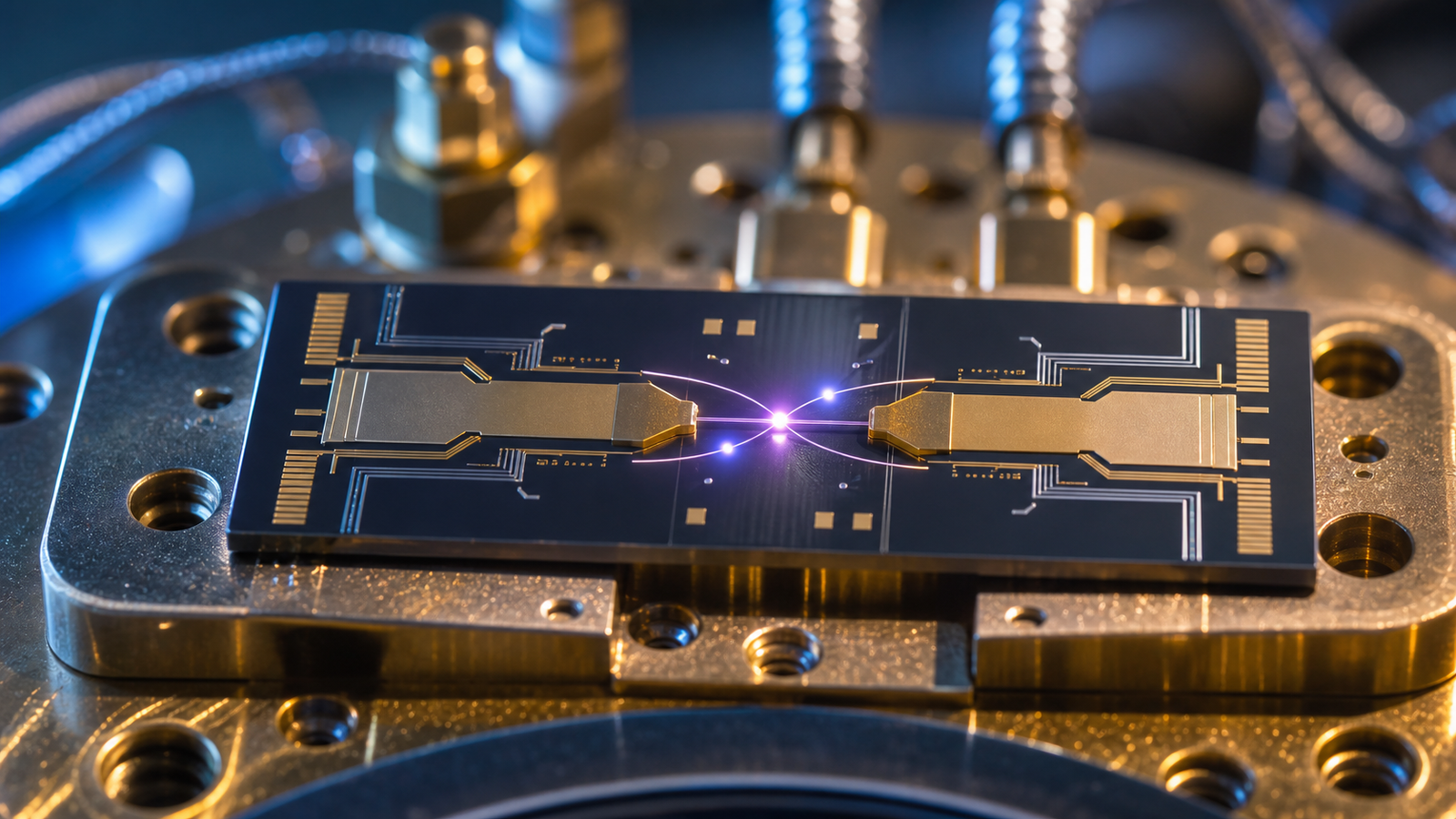
A Josephson junction is a device made from two superconductors separated by a very thin insulating barrier. Classical physics says current should not pass through the insulating barrier. Quantum mechanics says something more interesting can happen.
In a superconductor, electrons can form pairs known as Cooper pairs. These pairs move together without electrical resistance. Because many Cooper pairs act collectively, the superconductor can be described by a shared quantum wave function.
When two superconductors are separated by a thin barrier, Cooper pairs can tunnel through the barrier. This creates a supercurrent, meaning current can flow with zero voltage across the junction. This is known as the Josephson effect.
Macroscopic Quantum Tunneling
The breakthrough was not simply that individual particles could tunnel. Scientists already knew that quantum tunneling happened at microscopic scales. The key discovery was that an entire collective quantum state in a circuit could tunnel as one system.
This is called macroscopic quantum tunneling. "Macroscopic" means the effect involves a larger system than a single particle. In this case, the relevant quantum variable represented the collective behavior of many Cooper pairs in a superconducting circuit.
The experiment showed that a larger engineered object could display behavior that was unmistakably quantum. This result helped bridge the gap between the microscopic quantum world and the classical world of everyday objects.
How the Experiment Worked
The researchers used a Josephson junction cooled to extremely low temperatures in a dilution refrigerator. These temperatures were close to absolute zero, which helped protect the system from heat and outside noise.
The circuit was also shielded from magnetic and microwave interference. This was necessary because quantum states are fragile. Small disturbances can destroy the coherence needed to observe quantum effects.
As the current through the junction increased, the system initially behaved like a superconductor: a steady supercurrent flowed with no voltage. At a critical point, the researchers observed a sudden voltage spike. This indicated that the collective quantum state had escaped its trapped condition through tunneling.
To prove the effect was quantum rather than classical, the team studied how the escape rate changed with temperature. At very low temperatures, the escape rate became independent of temperature. That ruled out ordinary thermal activation and supported the conclusion that the system was tunneling quantum mechanically.
Why the Discovery Matters
This discovery matters because it confirmed that quantum mechanics can operate at a scale larger than individual particles. It also gave researchers a practical system for controlling and measuring quantum states in electrical circuits.
The work helped answer deep questions about where the quantum world ends and the classical world begins. It also supported the development of new technologies based on superconducting circuits.
- It showed that engineered circuits can behave quantum mechanically.
- It proved that collective quantum states can tunnel through energy barriers.
- It helped establish the physics behind superconducting qubits.
- It connected fundamental quantum theory with practical quantum technology.
- It demonstrated the value of curiosity-driven research.
Connection to Quantum Computing
Modern quantum computers need qubits that can be created, controlled, measured, and protected from noise. Superconducting qubits are built from circuits that rely on Josephson junctions and related quantum effects.
The Nobel-winning research helped scientists understand how macroscopic electrical circuits can behave like quantum systems. That understanding is essential for designing quantum processors, controlling qubit states, and reducing errors.
The discovery did not instantly create today's quantum computers, but it provided a crucial piece of the scientific foundation. It showed that quantum effects could be engineered in circuits, not only observed in isolated atoms or particles.
Timeline of Key Events
| Year or Stage | Event | Why It Matters |
|---|---|---|
| 1935 | Schrodinger introduces the cat thought experiment. | It highlights the strange question of quantum behavior in larger systems. |
| 1973 | Brian Josephson receives the Nobel Prize for work related to tunneling in superconductors. | The Josephson effect becomes a foundation for superconducting quantum circuits. |
| 1980s | Clarke, Devoret, and Martinis study macroscopic quantum tunneling in superconducting circuits. | Their experiments show that larger electrical systems can display quantum behavior. |
| Experiment | A Josephson junction is cooled to millikelvin temperatures and carefully measured. | Low temperature and shielding allow quantum effects to appear clearly. |
| Observation | A voltage spike appears at a critical current. | The spike signals escape of the collective quantum state through tunneling. |
| 2025 | The Nobel Prize in Physics recognizes the discovery. | The award highlights the discovery's importance for quantum technology. |
Experimental Setup and Findings
| Aspect | Details |
|---|---|
| System | A Josephson junction made from two superconductors separated by a thin insulating barrier. |
| Temperature | Extremely low millikelvin temperatures using a dilution refrigerator. |
| Measurement | Current and voltage changes across the junction. |
| Key observation | A sudden voltage spike at a critical current. |
| Quantum evidence | At ultra-low temperatures, the escape rate became independent of temperature. |
| Significance | The result demonstrated macroscopic quantum tunneling and supported the physics of superconducting qubits. |
Key Concepts and Terminology
| Term | Meaning |
|---|---|
| Quantum tunneling | A quantum effect where a particle or system passes through a barrier it could not cross in classical physics. |
| Wave function | A mathematical description of the probability state of a quantum system. |
| Cooper pairs | Pairs of electrons that move together in a superconductor without resistance. |
| Josephson junction | A device with two superconductors separated by a thin insulating barrier. |
| Macroscopic quantum tunneling | Tunneling by a collective quantum state involving many particles or a larger engineered system. |
| Thermal activation | A classical process where heat gives a system enough energy to escape over a barrier. |
| Superconducting qubit | A qubit built from superconducting electrical circuits, often using Josephson junctions. |
Frequently Asked Questions
Who won the 2025 Nobel Prize in Physics?
The 2025 Nobel Prize in Physics was awarded to John Clarke, Michel H. Devoret, and John M. Martinis for work on macroscopic quantum mechanical tunneling and energy quantization in an electric circuit.
What is quantum tunneling in simple words?
Quantum tunneling is when a quantum particle or system appears on the other side of a barrier that it would not be able to cross according to classical physics.
What is macroscopic quantum tunneling?
Macroscopic quantum tunneling happens when a larger collective system, not just a single particle, behaves quantum mechanically and tunnels through an energy barrier.
Why are Josephson junctions important?
Josephson junctions allow Cooper pairs to tunnel between superconductors. They are essential components in many superconducting quantum circuits and qubits.
How does this relate to quantum computers?
Many quantum computers use superconducting qubits built from circuits that depend on Josephson junctions. The Nobel-winning work helped prove that such circuits can support controllable quantum behavior.
Was this research immediately practical?
No. It began as fundamental physics research. Over time, however, it became important for quantum computing, quantum information science, and superconducting circuit technology.
Conclusion
The Nobel-winning discovery of macroscopic quantum tunneling showed that quantum mechanics can appear in engineered electrical circuits, not only in isolated microscopic particles. By using superconductors, Josephson junctions, ultra-low temperatures, and precise measurements, the researchers demonstrated that a collective electrical state could tunnel through a barrier as a quantum system.
This achievement deepened our understanding of the boundary between the quantum and classical worlds. It also helped create the scientific foundation for superconducting qubits, one of the most important technologies in the race to build useful quantum computers.
The lesson is clear: fundamental research can seem abstract at first, but it can later become the basis for technologies that reshape science, computing, communication, and security.
About the Author
The editorial team creates clear, reader-friendly explainers about science, technology, computing, and digital innovation. Articles are structured for readability, source quality, and search-friendly publishing.
Leave a comment
Your email address will not be published. Required fields are marked *