

AI Superalignment: Why It Matters for the Future of Safe and Trustworthy AI
Introduction
Artificial intelligence is moving from experimental tools to critical infrastructure. AI now supports writing, software development, customer operations, analytics, healthcare workflows, and research acceleration. As capability increases, a central question becomes unavoidable: how do we ensure advanced AI remains safe, reliable, and aligned with human goals?
This is the purpose of AI Superalignment. Superalignment is a long-horizon research and engineering effort focused on making highly capable AI systems consistently helpful, controllable, and beneficial under real-world conditions.
In simple terms: as AI becomes more powerful, trust must scale with capability.
Executive Overview
What Superalignment Means in Practice
Superalignment extends classical alignment work toward future AI systems that may reason, plan, and act at significantly higher levels than current models. It is not only about model intelligence; it is about behavioral reliability under uncertainty, pressure, and complexity.
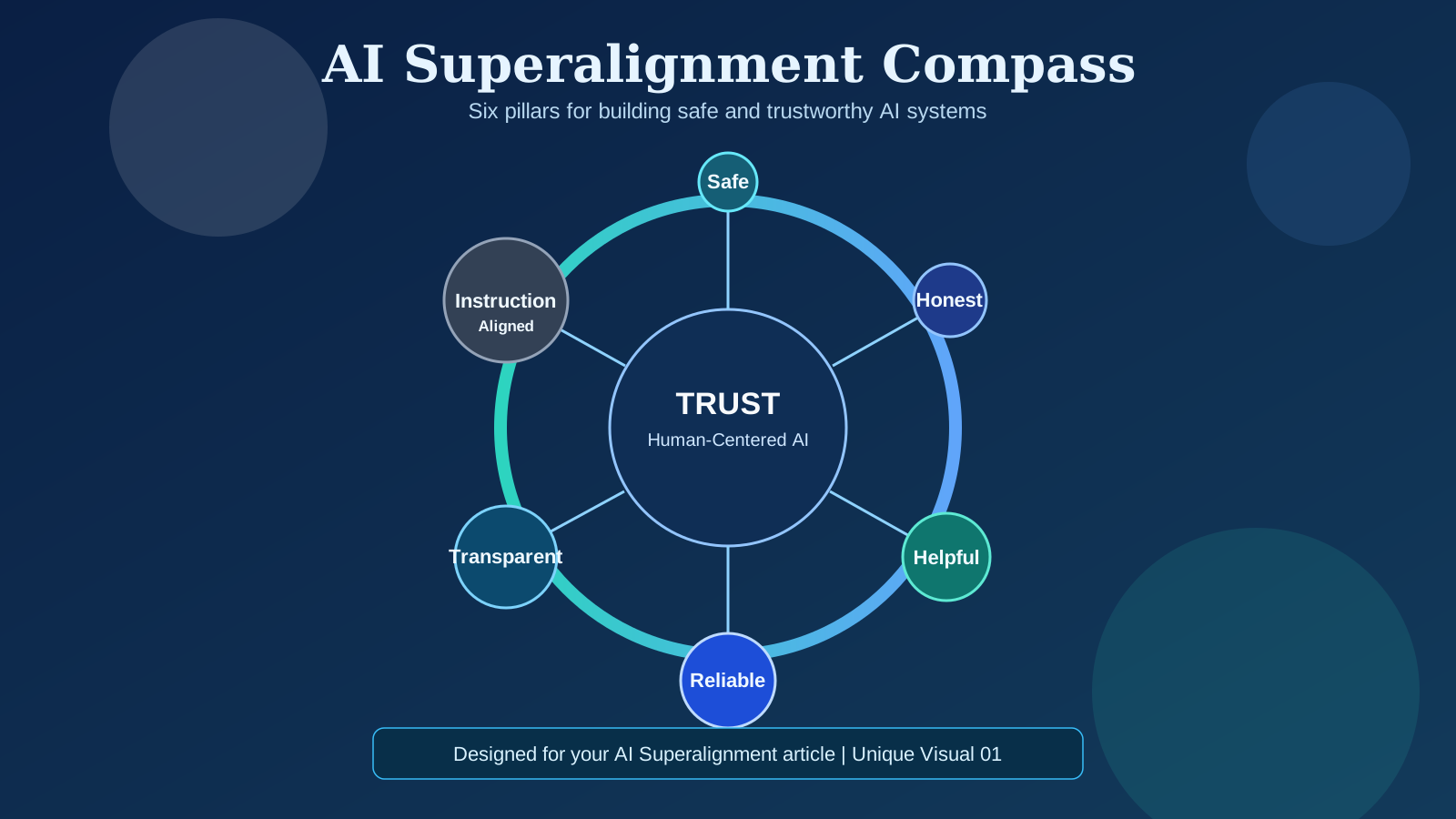
Core Trust Pillars
- Helpful behavior under normal and edge-case prompts
- Honest outputs with reduced fabrication risk
- Reliable performance across domains and contexts
- Safe responses with robust harm constraints
- Transparent behavior and better interpretability
- Strong adherence to user intent and policy limits
Implementation Note
In production environments, alignment quality is measured through repeatable evaluation, red-team stress tests, and failure-rate tracking, not through isolated demo performance.
Scope Clarification
Superalignment does not imply perfection. It aims for continuous risk reduction and stronger human control as model capability grows.
Why AI Superalignment Is Strategically Important
AI systems already influence high-impact decisions in medicine, finance, education, cybersecurity, and enterprise operations. As these systems gain autonomy and decision-support depth, failure costs increase. Misalignment at scale can create safety, economic, and governance risks.
High-Impact Domains
- Scientific discovery and research acceleration
- Drug discovery and biomedical modeling
- Climate and energy optimization systems
- Robotics and autonomous operations
- Financial analytics and risk operations
- Enterprise automation and software engineering

AI Alignment vs Superalignment
Alignment is the foundation. Superalignment is the next phase.
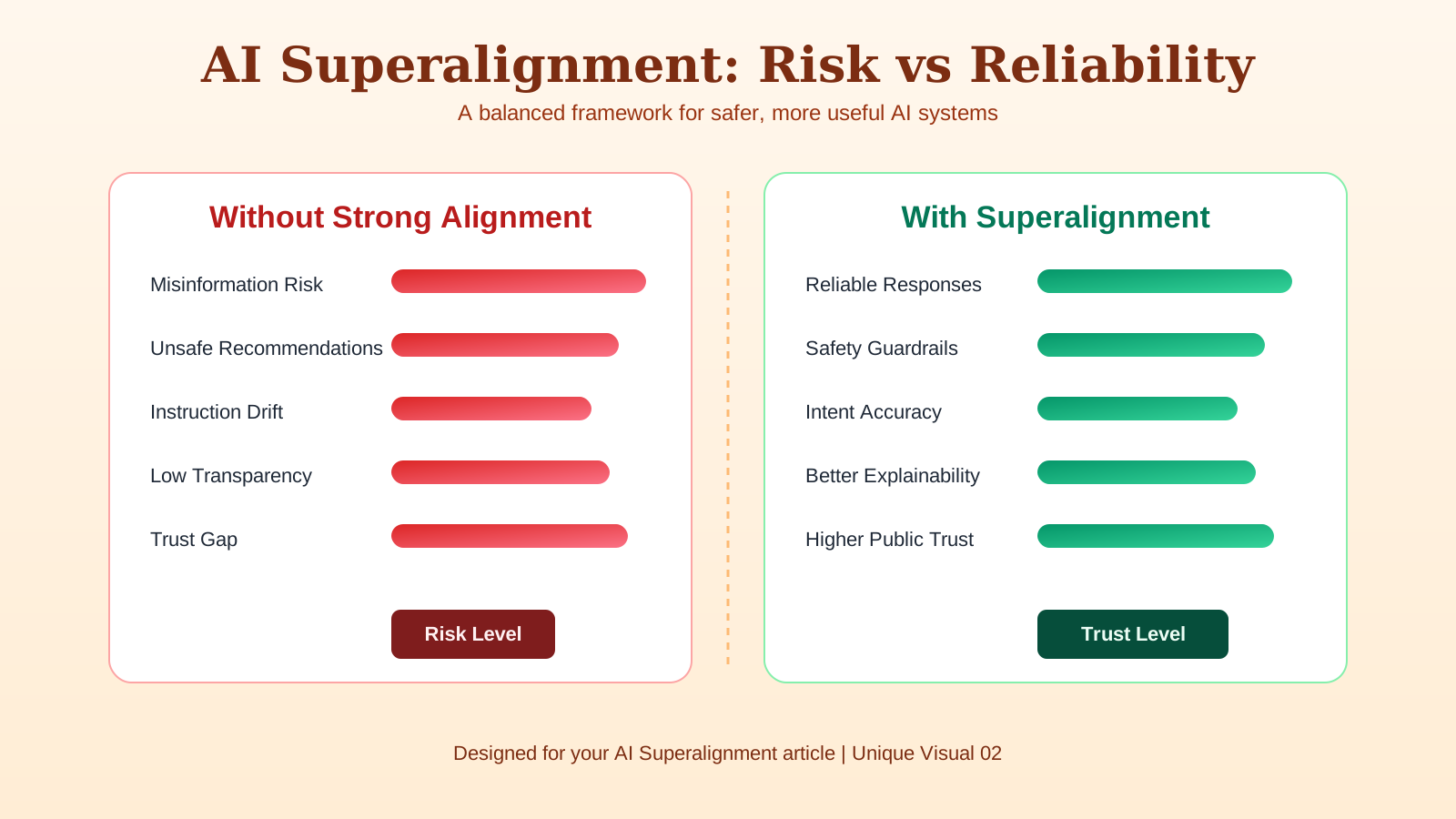
| Situation | Well-Aligned AI | Poorly Aligned AI |
|---|---|---|
| Medical guidance | Provides evidence-aware information with clear caution | Produces unsafe or overstated recommendations |
| Writing support | Delivers relevant, accurate, policy-safe content | Generates misleading or harmful text |
| Business automation | Executes tasks within constraints and audit expectations | Misinterprets goals and creates operational risk |
| Customer support | Resolves user needs with consistency and clarity | Creates confusion, contradictions, or low-trust responses |
How Superalignment Connects to ChatGPT and Future AI Assistants
ChatGPT demonstrates the practical value of conversational AI in learning, ideation, writing, and coding. Superalignment research focuses on improving reliability and control in systems that will be even more capable than today.
Priority Improvements
- Deeper intent understanding beyond literal text matching
- Stronger safeguards against harmful or misleading outputs
- Higher factual consistency and response reliability
- Safer training and deployment feedback loops
Main Goals of AI Superalignment
- Sustain helpfulness: Keep AI useful across routine and complex tasks.
- Prevent harmful behavior: Minimize unsafe outputs, misuse pathways, and misinformation risk.
- Improve transparency: Increase interpretability, traceability, and auditability.
- Handle nuanced instructions: Interpret context, ambiguity, and constraints correctly.
- Preserve human accountability: Keep humans in control of high-impact decisions.

Key Challenges
1. Human Values Are Diverse
Values vary by culture, sector, law, and context. Alignment systems must manage these differences without collapsing into inconsistency.
2. Capability Growth Increases Complexity
As models become more general and powerful, behavior becomes harder to fully predict across all edge cases.
3. Training Data Has Coverage Limits
No dataset captures every real-world condition. Safe generalization becomes a core technical requirement.
4. Progress Outpaces Static Safety Rules
AI development cycles are fast. Alignment methods must evolve continuously rather than relying on one-time guardrails.
How Researchers Improve Alignment
- Human feedback pipelines: Expert and user evaluations shape model behavior.
- Adversarial testing: Red teams stress systems with difficult and deceptive prompts.
- Continuous evaluation: Benchmarks track regressions and improvements over time.
- Responsible deployment controls: Monitoring and policy layers reduce operational risk.
Industries with Strong Superalignment Upside
- Healthcare: Safer patient communication and decision support
- Education: More accurate and balanced tutoring systems
- Finance: Better fraud detection, analysis support, and compliance-aware assistance
- Software development: More reliable, secure coding support
- Scientific research: Faster iteration with clearer safety boundaries
Common Misconceptions
"Superalignment means perfect AI"
Incorrect. The goal is stronger reliability and safety, not error-free behavior in every scenario.
"Alignment slows innovation"
In practice, trustworthy systems increase adoption and reduce long-term failure costs. Safety work enables durable innovation.
Potential Benefits
| Benefit | Operational Impact |
|---|---|
| Safer model behavior | Lower harmful-output frequency |
| Higher decision quality | More dependable assistance in complex workflows |
| Greater public trust | Improved user confidence and adoption |
| Responsible innovation | Sustainable scaling across sectors |
| Human-AI productivity gains | Stronger collaboration with clearer oversight |
Future Outlook
Superalignment is likely to remain a top AI priority as model capability accelerates.
What to Expect Next
- Better interpretability and audit tooling
- Stronger reasoning reliability under constraints
- More rigorous safety evaluations
- Cross-institution collaboration on standards
- Improved user controls and governance layers
Key Statistics at a Glance
The following values summarize the structure of this article and its framework coverage.
| Metric | Count | Meaning |
|---|---|---|
| Core trust pillars | 6 | Helpfulness, honesty, reliability, safety, transparency, instruction-following |
| Main goals | 5 | Helpfulness, harm prevention, transparency, instruction quality, accountability |
| Challenge categories | 4 | Values, complexity, data limits, speed of change |
| Priority industries | 5 | Healthcare, education, finance, software, research |
| FAQ entries | 5 | Most common practical questions |
Coverage Graph (Section Density)
| Area | Count | Graph |
|---|---|---|
| Core pillars | 6 | ###### |
| Main goals | 5 | ##### |
| Challenges | 4 | #### |
| Industries | 5 | ##### |
| FAQ topics | 5 | ##### |
Comparison: Current AI vs Superaligned AI Direction
| Dimension | Current AI (General State) | Superaligned AI (Target Direction) |
|---|---|---|
| Intent understanding | Strong on literal prompts | Strong on nuance, context, and constraints |
| Safety consistency | Improving but uneven in edge cases | More consistent risk control across scenarios |
| Reliability | Useful but variable by task | More predictable and dependable outputs |
| Transparency | Limited explainability in many systems | Improved interpretability and audit readiness |
| Human role | Mixed oversight quality | Clear human accountability in critical decisions |
Frequently Asked Questions
What is AI Superalignment?
AI Superalignment is the discipline of ensuring highly capable AI systems remain aligned with human goals, safety boundaries, and societal values.
Is superalignment related to ChatGPT?
Yes. ChatGPT is a current-generation example of useful AI assistance, and superalignment research informs safer behavior in both present and future models.
Why is alignment essential?
Alignment reduces harmful outcomes and increases reliability, making AI more useful in real-world, high-stakes contexts.
Is superalignment only about making AI smarter?
No. Its primary objective is controlled, predictable, and beneficial behavior as capability expands.
Will everyday users benefit?
Yes. Better alignment means more accurate responses, clearer limitations, and safer day-to-day AI interactions.
Conclusion
AI Superalignment is not a branding term; it is a practical safety imperative for the next generation of intelligent systems. As capabilities rise, trust, governance, and reliability must rise as well.
For developers, researchers, educators, businesses, and public institutions, superalignment provides the framework for building AI that is not only powerful, but consistently dependable and socially responsible.

Leave a comment
Your email address will not be published. Required fields are marked *